
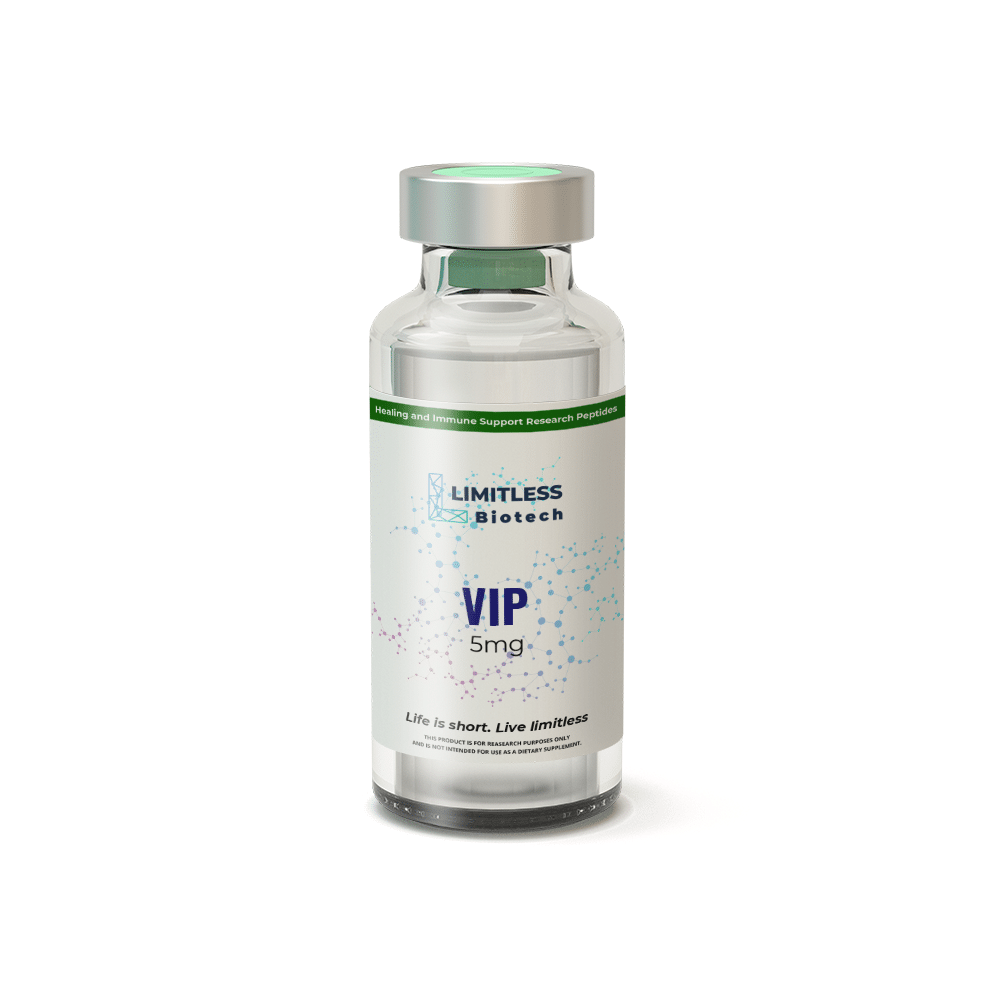
Vasoactive Intestinal Peptide (VIP) – Premium Research Peptide for Advanced Scientific Investigation
Vasoactive Intestinal Peptide (VIP)
Vasoactive Intestinal Peptide (VIP) is a highly studied neuropeptide consisting of 28 amino acids that plays a significant role in numerous physiological processes. Originally isolated from the intestinal tract, VIP has since been identified throughout the central and peripheral nervous systems, where it functions as an important signaling molecule involved in cellular communication, neurological pathways, immune responses, and smooth muscle regulation.
Due to its broad biological activity and extensive distribution throughout mammalian tissues, Vasoactive Intestinal Peptide has become a valuable compound in modern peptide research. Scientists continue to investigate VIP’s influence on neuroendocrine function, inflammatory signaling, cellular protection mechanisms, and receptor-mediated pathways.
Researchers across multiple disciplines utilize VIP in laboratory settings to better understand peptide-receptor interactions and the complex communication networks that regulate biological systems.
What Is Vasoactive Intestinal Peptide?
Vasoactive Intestinal Peptide belongs to the secretin/glucagon family of peptides and acts primarily through VPAC1 and VPAC2 receptors. These receptors are distributed throughout numerous tissues and organs, making VIP an important subject in research involving cellular signaling and physiological regulation.
VIP is naturally produced in nerve fibers, the gastrointestinal tract, lungs, pancreas, immune cells, and various regions of the brain. Its widespread presence demonstrates the peptide’s significance in maintaining communication between multiple biological systems.
The peptide has attracted considerable scientific interest because of its ability to influence \ pathways associated with neurological activity, immune system responses, and smooth muscle function.
Key Characteristics of VIP
Researchers frequently study VIP due to several unique characteristics:
- Composed of 28 amino acids
- Member of the secretin peptide family
- Interacts with VPAC1 and VPAC2 receptors
- Found throughout the nervous system
- Present in gastrointestinal tissues
- Involved in cell signaling pathways
- Widely researched in immunological studies
- Investigated in respiratory and neurological research
These characteristics have made VIP one of the most extensively studied neuropeptides in modern biomedical research.
Scientific Interest in VIP Research
The broad biological distribution of VIP has generated significant scientific attention. Research programs often focus on understanding how VIP influences communication between cells and how receptor activation affects various physiological processes.
Areas of investigation commonly include:
Neurological Research
VIP is highly concentrated within specific regions of the nervous system. Researchers study its involvement in neuronal signaling, circadian rhythm regulation, neurotransmitter activity, and neuroprotective pathways.
Laboratory investigations continue to examine how VIP interacts with neural networks and contributes to cellular communication throughout the brain and peripheral nervous system.
Immune System Research
VIP has become a major subject of interest in immunology due to its interaction with immune cells. Scientists investigate its role in cytokine regulation, immune cell signaling, and inflammatory response pathways.
Research involving VIP may contribute to a greater understanding of immune balance and communication among immune cell populations.
Respiratory Research
VIP receptors are present throughout respiratory tissues. As a result, researchers frequently explore the peptide’s role in airway signaling pathways and respiratory physiology.
Studies continue to evaluate receptor-mediated mechanisms involving VIP and their potential significance in respiratory system research models.
Gastrointestinal Studies
Because VIP was first discovered in intestinal tissue, gastrointestinal research remains an important area of focus. Scientists examine how the peptide interacts with digestive tissues and influences cellular signaling throughout the gastrointestinal tract.
Research efforts often investigate secretory mechanisms, smooth muscle activity, and peptide-mediated communication within digestive systems.
Endocrine Research
VIP participates in communication between the nervous and endocrine systems. Researchers continue to investigate its involvement in hormone-related signaling pathways and neuroendocrine interactions.
These studies provide valuable insights into the coordination of physiological responses across multiple biological systems.
Importance of VIP Receptors
One of the most compelling aspects of VIP research involves its receptor interactions.
VIP primarily binds to:
VPAC1 Receptor
The VPAC1 receptor is expressed in numerous tissues and plays a key role in mediating peptide signaling. Researchers frequently investigate receptor activation and downstream cellular responses associated with VPAC1 pathways.
VPAC2 Receptor
VPAC2 receptors are widely distributed throughout the nervous system and immune tissues. Studies involving VPAC2 activation help scientists understand how VIP influences communication among specialized cells.
Understanding these receptor systems remains a central objective in peptide science and molecular biology research.
Benefits of High-Purity Research VIP
Researchers prioritize high-purity peptides because purity can significantly influence experimental consistency and reproducibility.
Premium-quality VIP research material may offer:
- Enhanced experimental reliability
- Improved analytical accuracy
- Greater batch consistency
- Reduced interference from impurities
- Better reproducibility of results
- Higher confidence in laboratory findings
These qualities make high-purity VIP an essential component for advanced peptide research applications.
Laboratory Applications of VIP
Vasoactive Intestinal Peptide is commonly utilized in a variety of scientific settings.
Potential laboratory applications include:
Cell Culture Research
VIP may be incorporated into cellular studies examining receptor activation, intracellular signaling pathways, and molecular communication mechanisms.
Molecular Biology Studies
Researchers use VIP to investigate gene expression patterns, protein interactions, and receptor-mediated signaling cascades.
Neurobiology Research
The peptide is frequently employed in studies focused on neuronal communication, neurochemical signaling, and central nervous system physiology.
Immunological Investigations
VIP remains a valuable research tool for exploring immune system communication and cellular response pathways.
Receptor Binding Studies
Scientists use VIP in experiments designed to analyze receptor affinity, selectivity, and downstream biological responses.
Why Researchers Choose VIP
Several factors contribute to the continued popularity of VIP within scientific communities.
Researchers value VIP because it:
- Has extensive scientific literature
- Demonstrates broad physiological relevance
- Interacts with well-characterized receptors
- Supports multidisciplinary research initiatives
- Serves as a useful model for peptide signaling studies
- Provides insight into cellular communication networks
Its versatility makes VIP applicable to numerous research programs across diverse scientific disciplines.
Storage and Handling
To maintain peptide integrity and stability, VIP should be handled according to established laboratory protocols.
General recommendations include:
- Store under appropriate temperature conditions
- Minimize repeated freeze-thaw cycles
- Use sterile laboratory techniques
- Protect from excessive moisture and contamination
- Follow all applicable research guidelines
Proper storage practices help preserve peptide quality throughout the duration of experimental studies.
The Growing Importance of Peptide Research
The field of peptide science continues to expand rapidly as researchers discover new applications for biologically active compounds. Peptides like VIP provide valuable opportunities to explore cellular communication, receptor biology, and molecular signaling mechanisms.
As scientific understanding advances, researchers increasingly rely on well-characterized peptides to investigate complex physiological systems. VIP remains one of the most important neuropeptides for these investigations due to its widespread distribution and diverse biological activities.
Premium Vasoactive Intestinal Peptide for Research Use
Vasoactive Intestinal Peptide continues to serve as a critical tool in modern scientific research. Its involvement in neurological pathways, immune signaling, respiratory studies, gastrointestinal research, and receptor biology has established vasoactive intestinal peptide as a highly valuable peptide for laboratory investigation.
Researchers seeking a high-quality peptide for advanced studies appreciate vasoactive intestinal peptide’s extensive scientific background, well-defined receptor interactions, and broad applicability across multiple disciplines. Whether examining neuropeptide signaling, immune communication, receptor activation, or cellular pathways, VIP remains an essential compound in contemporary peptide research.
Variable SEO Keywords
Vasoactive Intestinal Peptide, VIP peptide, VIP research peptide, Vasoactive Intestinal Peptide for sale, VIP peptide research, neuropeptide research compound, high purity VIP peptide, laboratory grade VIP, peptide receptor research, VPAC1 receptor peptide, VPAC2 receptor research, VIP signaling peptide, immune modulation peptide research, neurobiology peptide, gastrointestinal peptide research, respiratory peptide studies, peptide laboratory research, scientific peptide supplier, premium VIP peptide, research peptides online, peptide signaling pathways, neuroendocrine peptide research, cell signaling peptide, biotechnology peptide research, peptide science compound, advanced peptide studies, research-grade neuropeptide, VIP laboratory compound, peptide receptor agonist research, high-quality research peptide.
Reviews
There are no reviews yet.